



New

Synheart's infrastructure is live. On-device inference is free, forever.

Synheart

SYNHEART RESEARCH

Understanding human states in behavior.

Synheart researches how physiological signals, movement, and digital behavior can be modeled with machine learning and behavioral science to infer human state in real time. Every insight becomes part of the Human State Interface (HSI), the infrastructure behind our products and SDKs.

Person in motion, blurred in orange

RESEARCH AREAS

What we study.

  • Physiological Computing

    What can the body tell us about changing human state?

    • HR & HRV
    • Autonomic dynamics
    • Signal quality
    • Biomarkers
    • Motion
    • Signal quality
  • Multimodal Human-State Modeling

    How can physiology, behavior, motion, and context be combined to infer human state?

    • Multimodal fusion
    • Stress
    • Focus
    • Fatigue
    • Cognitive load
    • Arousal
  • Focus & Cognitive Control

    What does sustained attention in HRV and motion data look like?

    • Attention stability
    • Flow probability
    • Cognitive drift,
    • Distraction signatures,
    • Cognitive load scoring
  • Digital Behavior & HCI

    Can micro-motion and timing patterns reveal behavioral state?

    • Typing bursts
    • Scroll velocity
    • App switching
    • Micro-distractors
    • Attention-fragility models
  • Personalized & Longitudinal Modeling

    How can models learn each person’s baseline and track state changes over time?

    • Personal baselines
    • SRM
    • adaptation
    • state trajectories
    • recovery
  • Edge & Privacy-Preserving AI

    Can human-state intelligence stay accurate and personalized while raw data remains on-device?

    • Edge AI
    • on-device inference
    • private personalization
    • federated learning

CASE STUDIES

Research, followed through to results.

Each case study follows one research question from hypothesis to finding, and where relevant, into what shipped. 2 active studies, more added as they progress.

LIVE

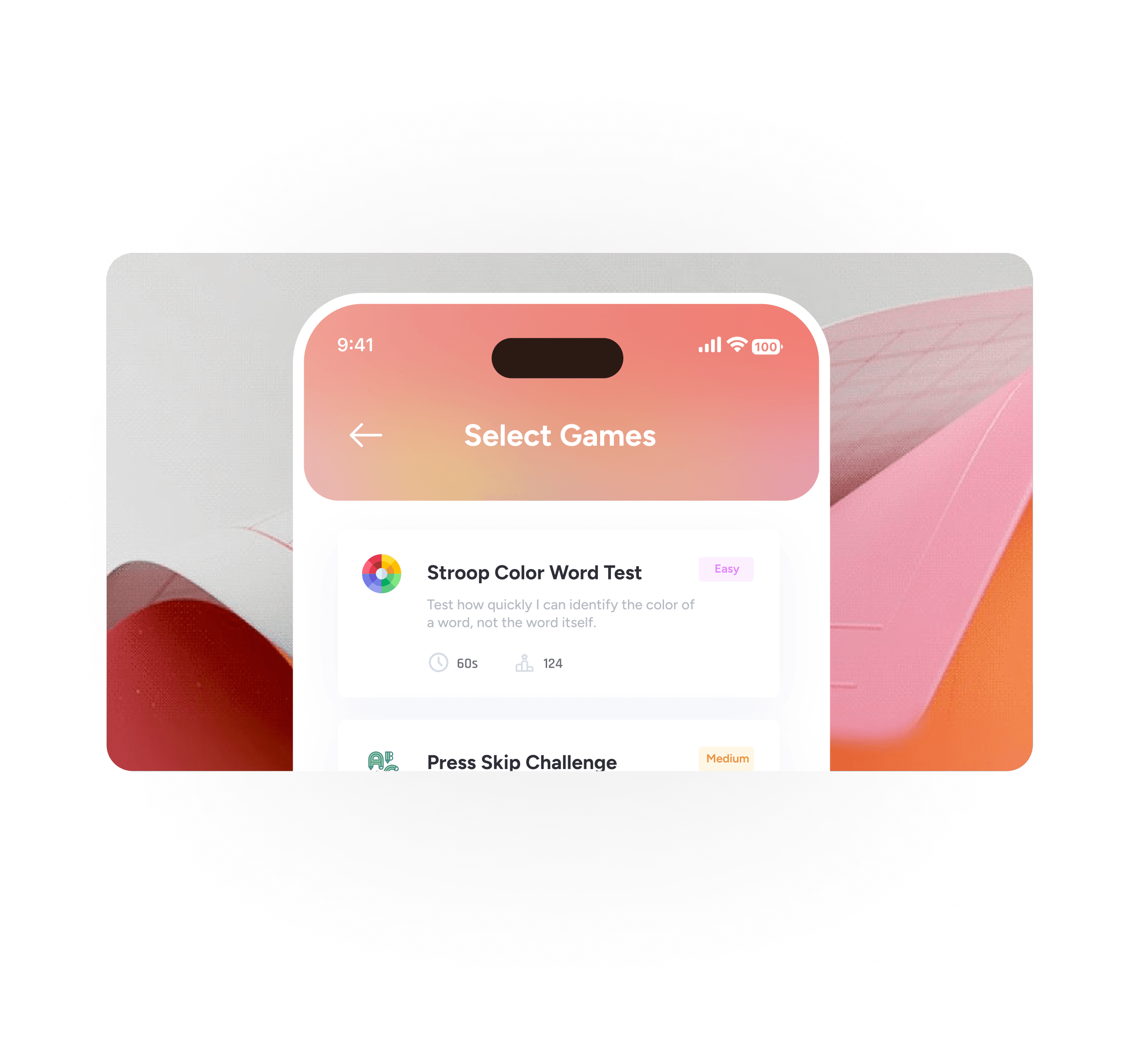
Pulse Focus Cognitive Game Research Platform

Pulse Focus Cognitive Game Research Platform

A Research Tool From Synheart Uses Cognitive Games To Collect Multimodal Data: Physiological Signals, Behavioral Patterns, And Interactions. It’s Open To Researchers And Developers.

  • Cognitive Games
  • Stroop Paradigm
  • Attentional Control
  • Neural Validation
Read the full case study
ACTIVE

Integrating Human State Into Language Models

Integrating Human State Into Language Models

An active research program investigating how real-time human state signals, stress and focus among them, can be integrated into language model inference to produce responses adapted to a person’s state at the moment of interaction.

  • LLM Integration
  • Human State + NLP
  • Context-Aware AI

Can a language model with real-time human state context produce meaningfully better, more contextually appropriate responses than one operating on text alone?

Publication expected, follow for updates

OPEN SCIENCE

Publications

5 Papers
  • Preprint

    Pulse Focus: Validation of the Focus Performance Score as a Behavioral Signal for Human Attentional State Modeling Toward Attention-Aware AI

    Validates the Focus Performance Score from the Pulse Focus Stroop game as a reliable, neurally grounded measure of attentional control.


  • Preprint

    Synheart Capacity: A Theory-Driven Physiological Representation of Cognitive Capacity Dynamics from Wearable Signals

    Models cognitive capacity as two physiological states, mental effort and stress, estimated from wearable cardiac and electrodermal signals.

  • Preprint

    Synheart HSI: The Human State Interface Infrastructure Before Interpretation

    Defines a privacy-first, on-device standard for human state: the Human State Vector to represent it and the Human State Interface to exchange it.

  • Preprint

    Synheart Behavior: A Privacy-Preserving Framework for Modeling Digital Behavior Numerically

    Turns taps, scrolling, idle time and app switching into numerical behavior metrics, without collecting any content or personal identifiers.

  • Preprint

    Synheart Emotion: Privacy-Preserving On-Device Emotion Recognition from Biosignals

    Compares classical, deep learning and transformer models for on-device emotion recognition from wrist PPG, and deploys a compact ONNX model.

HOW WE WORK

Our Principles

Woman in profile with layered images inside her silhouette
  1. Privacy First

    Inference runs entirely on-device. Raw biosignals never leave the user’s phone or wearable unless the user explicitly consents. Human State Intelligence should never come at the cost of privacy.

  2. Research to Real Product

    Our work doesn’t stay in papers. We design research with deployment in mind, prioritizing robustness, interpretability, and real-world constraints from day one. Every insight becomes part of HSI.

  3. Open Science

    We publish our research, open-source our models, and release our datasets publicly. The biosignal research community should be able to inspect, replicate, and extend our work freely.

WHO BUILDS ON SYNHEART

Open Datasets & Models

  • Dataset

    PAMAP2 Physical Activity Monitoring

    The PAMAP2 benchmark (Reiss, 2012): 18 physical activities recorded from 9 people wearing three motion sensors and a heart-rate monitor.

    • 688 MB
    • 9 subjects
    • 18 activities
  • Model

    Synheart Binary Emotion Classification Models (ONNX)

    ExtraTrees models that tell baseline from stress using heart rate variability features, built to run on the device with ONNX Runtime.

    • 74.5% accuracy
    • WESAD
    • Apache-2.0
  • Model

    Syni Life Gemma 3 1B (GGUF)

    Google’s Gemma 3 1B Instruct in 4-bit GGUF (Q4_K_M), packaged so Syni, the companion in Life by Synheart, can run it on the device.

    • 806 MB
    • Q4_K_M
    • Gemma license

AND WHAT’S BUILT ON IT

Collaborations & partners.

Synheart strengthens research via partnerships and collaborations with universities and labs. We focus on privacy-first, human-centered AI. All collaborations, including early agreements, are listed here.

View all partners

Open Science & Ecosystem

Where our work is shared: open datasets, code, papers, and the wearables we support.

Dataset Hosting
Hugging Face
Open Source SDK
GitHub
Preprint publishing
arXiv
Wearable
Ecosystem

Research Advisors

Researchers who advise our work in physiology, human-computer interaction, and machine learning.

  • Sammy Assefa

    Research Advisor

    Sammy Assefa

  • Alemitu Bezabih

    HCI

    Alemitu Bezabih

  • Alexis Nolin-Lapalme

    MILA / MHI

    Alexis Nolin-Lapalme

University Research Partners

Universities we work with on human-state research.

  • Mila

Stay Updated

New papers, datasets, and case studies as they publish.

No spam, unsubscribe anytime